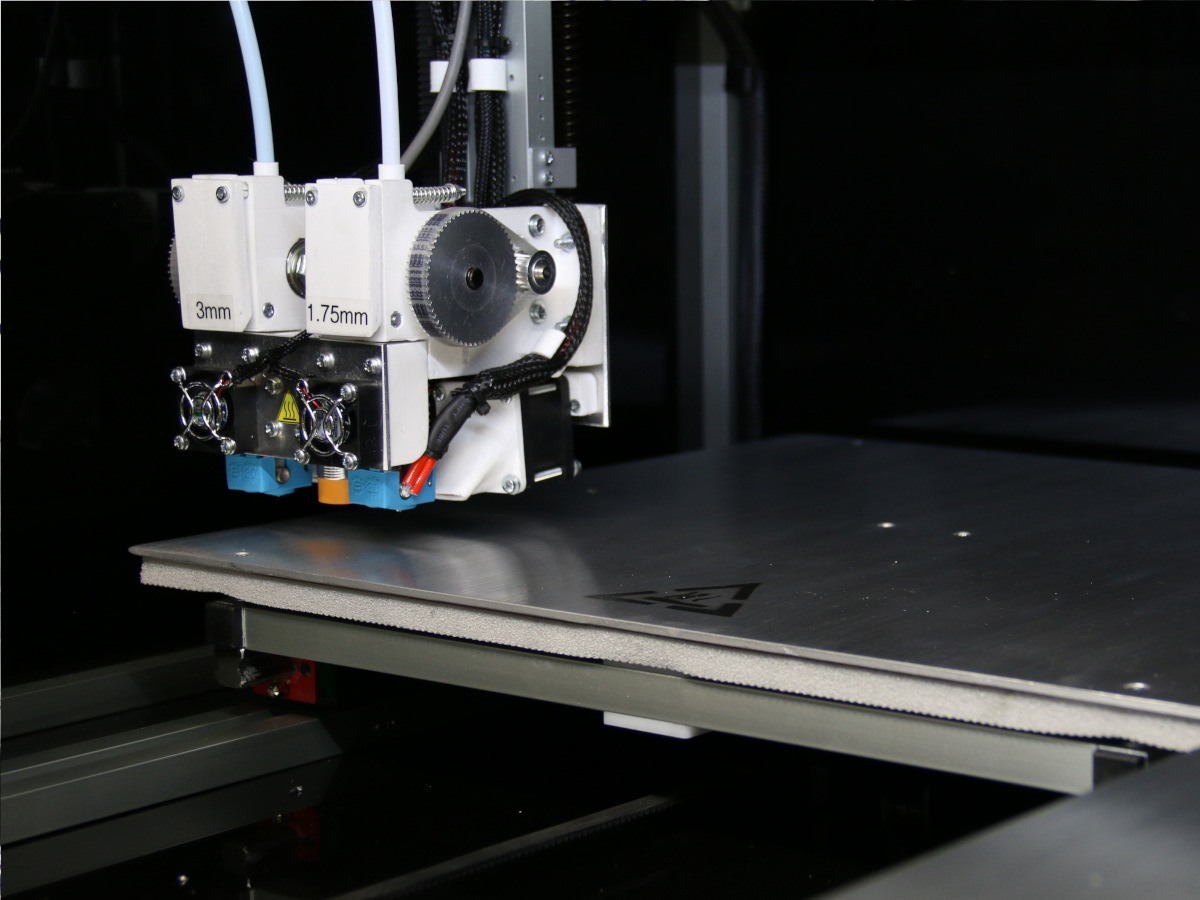
Large-scale 3D printing is becoming increasingly important in the development of industrial products and components. For many companies, the ability to create a large-scale functional prototype directly from a digital model represents an opportunity to accelerate the design, validation, and improvement phases of a product.
Unlike a prototype designed solely for visual inspection, a functional prototype must allow for concrete testing. It can be used to verify dimensions, assembly, ergonomics, strength, movement, or interaction between different components. When the parts are large, having an additive manufacturing technology capable of producing them is particularly advantageous.
Using a professional large-format 3D printer also allows you to quickly make design changes and produce new versions. This facilitates a development process based on multiple iterations, reducing lead times and allowing you to identify potential problems before moving on to final production.
What is a functional prototype?
A functional prototype is a physical representation of a product or component that allows you to verify certain characteristics related to its use.
While a visual prototype focuses primarily on appearance, a functional prototype aims to test the behavior of the object under conditions similar to its intended use.
Depending on the project, it can be used to test:
- Dimensions and tolerances.
- Assembly systems.
- Movement of different parts.
- Ergonomics.
- Mechanical resistance.
- Component location.
- Accessibility.
- Compatibility between elements.
- Operation of certain mechanisms.
3D printing allows these components to be created before final production begins and facilitates modifications if test results indicate that the design can be improved.
Why use large-format 3D printing?
The main advantage of large-scale 3D printing is the ability to produce bulky components without necessarily having to break them down into numerous parts.
A large prototype can be especially important when the actual dimensions directly influence the evaluation. A small-scale model may look correct on the screen, but it may not reveal some issues that become apparent when viewed at full size.
Large-format additive manufacturing allows you to work with full-size prototypes, providing more useful information during the validation process.
Reducing development times
One of the main advantages for companies is the possibility of reducing prototyping times .
Using traditional methods, producing a prototype can require molds, tooling, and multiple manufacturing operations. In some projects, these steps can significantly extend the timeframe. 3D printing allows you to start directly from the CAD model. Once the file is prepared and the parameters configured, the production process begins.
If a change is needed, the digital model can be updated and used to produce a new version.
This system favors an iterative methodology:
design → prototype → test → modification → new prototype.
The faster this cycle can be repeated, the faster product development can progress.
Large-scale functional prototypes
Large-format additive manufacturing is particularly interesting when the size of the component is an essential element of the test.
For example, a large-scale prototype can be used to analyze:
- Spaces for meetings.
- Ergonomics.
- Position of the different elements.
- Accessibility.
- Interaction between components.
- Shape and size.
- Compatibility with other components.
- Integration within a larger structure.
By realizing the component at its actual size, designers and engineers can identify problems that might go unnoticed during a digital simulation.
Reducing prototyping costs
Another important advantage is the possibility of producing unique pieces and small series.
In some projects, creating a custom mold for a single component may be impractical. 3D printing allows you to produce the component directly from the digital file, avoiding some of the initial investments associated with other methods.
Furthermore, when the project changes, there’s no need to create new tools. Simply modify the file and set up a new production process.
This can help control costs associated with different iterations of the prototype.
Greater design freedom
Additive manufacturing offers significant freedom in developing complex and custom geometries .
When designing a functional prototype, it’s possible to integrate various features directly into a single component. Lightweight internal structures, channels, reinforcements, or specific connection systems can also be developed.
This freedom can facilitate the creation of components optimized for the needs of each application.
Designing through additive manufacturing also allows you to adapt the geometry to reduce material consumption and improve the behavior of the part during printing.
Editable prototypes and multiple iterations
One of the most important features of 3D printing is the ease of modifying the digital model .
During the development phase, it’s common for a prototype to require several modifications. These might include changing a dimension, correcting a connection area, or altering the position of a component.
Thanks to additive manufacturing, these changes can be made directly to the CAD model and then used to produce a new version.
This procedure allows you to compare different alternatives and select the most suitable one before starting final production.
Materials for functional prototypes
The choice of material is fundamental when the prototype is to be used for functional testing.
Not all materials have the same characteristics. Some are primarily suited for visual models, while others may offer greater mechanical strength, rigidity, or thermal stability .
Depending on the technology and equipment used, different thermoplastic materials can be found, including:
- PLA.
- ABS.
- PETG.
- Polycarbonate.
- Polyamides.
- Fiber-reinforced materials.
- Composite materials.
The choice must be made based on the conditions in which the prototype will be used and on the characteristics that need to be validated.
Reinforced materials for demanding tests
In certain applications, fiber-reinforced materials can provide additional properties.
Composite materials can be used when the prototype needs specific stiffness or strength characteristics. The ability to work with these materials expands the applications of professional additive manufacturing.
However, the material must be compatible with the machine and production conditions. Printing parameters must also be considered, as they can directly influence the properties of the finished component.
Dimensional accuracy in large prototypes
Accuracy is especially important when the prototype needs to be assembled with other components.
In most cases, small deviations can cause problems in connection areas or overall dimensions. For this reason, machine stability and process control are crucial. Orientation, temperature, extrusion parameters, and geometry can all influence the result.
Proper model preparation and appropriate setup result in more consistent and useful prototypes for testing.
Monoblock prototypes
When the size allows, a large-format professional 3D printer can produce a complete prototype in a single piece.
This capability can reduce the need for assembly and allow certain tests to be performed on the completed component. Single-piece production can also facilitate the evaluation of proportions and the interaction between different areas.
However, extremely large components may require a modular strategy to improve stability and ease of handling.
Production of modular prototypes
Modular production involves dividing the prototype into different sections that are then assembled.
This strategy allows for working with elements that exceed the available building volume. Furthermore, each module can be oriented independently to optimize the process.
Another advantage is the ease of modification. If a section of the prototype needs to be updated, just the modified module can be produced.
This can reduce the time and cost of new iterations.
Applications in various sectors
Large-scale functional prototypes can be used in many industrial sectors.
Its applications include:
- Automotive industry .
- Industrial design.
- Machinery manufacturing.
- Engineering.
- Architecture.
- Industrial equipment.
- Tool development.
- Research and development.
- Small series production.
In all of these industries, having a physical prototype quickly can facilitate decision-making and accelerate development.
3D printing and large-format prototyping
In the large-format professional 3D printing industry, 3DPRN is associated with solutions oriented towards large-format additive manufacturing.
For a company needing to produce functional prototypes, it’s essential to evaluate several factors before choosing a solution. Production volume, compatible materials, precision, productivity, and reliability must all be analyzed together.
The right machine will be the one that allows the production of the necessary components while maintaining a balance between quality, production times and costs .
Integration between design and production
One of the main advantages of 3D printing is the close relationship between digital design and physical production .
The CAD model can be modified and reintroduced into the manufacturing process, creating a highly flexible development cycle. This integration allows companies to experiment with different geometries and develop functional prototypes without having to make substantial changes to the manufacturing infrastructure.
Digitizing the process also makes it easier to maintain multiple templates and versions, creating a useful history for future changes.
Waste reduction and material optimization
Additive manufacturing deposits material progressively, allowing for optimized use compared to some subtractive processes.
When manufacturing large components, waste reduction can be particularly important due to the sheer amount of material required.
The use of lightweight internal structures and appropriately configured infill can reduce weight and power consumption without necessarily compromising the functionality required for the prototype.
Materials optimization can help both reduce costs and improve overall process efficiency.
Prototype control and validation
Once the prototype has been created, a fundamental phase begins: validation.
The component can be subjected to various tests depending on the project’s objectives. The results obtained allow us to determine whether the geometry, material, and design meet expectations.
If a problem is detected, the digital model can be modified to create a new version.
This cycle of testing and improvement is one of the main advantages of 3D printing in product development .
From prototype to production
Creating a working prototype can also serve as a preliminary step to large-scale production. Testing the prototype allows us to identify potential improvements before finalizing the process.
Additionally, information gained during manufacturing can be used to optimize the design and determine which aspects need to be changed.
3D printing can also be used later to produce small batches or custom components , especially when large volumes are not needed.
Large-scale 3D printing for functional prototypes offers companies a flexible tool for developing and validating large components.
The ability to create full-scale models allows you to verify dimensions, ergonomics, assembly, geometry, and certain functional characteristics before starting final production.
Additionally, the link between the CAD model and physical manufacturing facilitates modifications and enables rapid iteration of the design, testing, and improvement cycle.
The availability of various technical materials , together with the possibility of producing in a single piece or through modules, further expands the field of application.
For companies, the main advantages lie in reduced development times, design flexibility, customization, cost optimization, and the ability to perform multiple iterations.
In this context, large-format additive manufacturing can become a strategic tool to accelerate product development and transform industrial prototyping, enabling a faster, more flexible, and more efficient transition from a digital idea to a large-scale functional prototype.


